
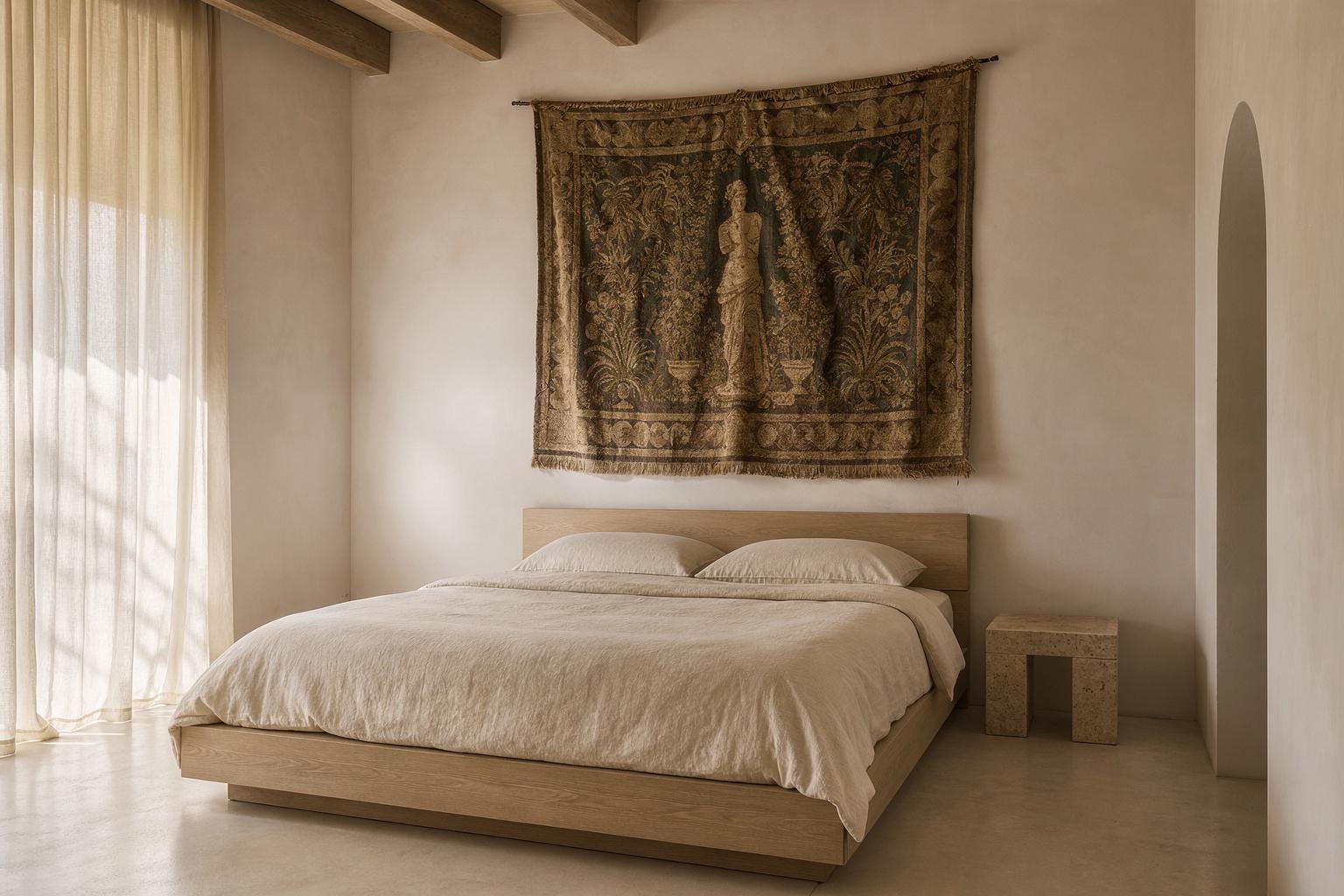
Wall art for boutique hotels should do more than complete an interiors checklist. It should help guests understand the property before anyone explains it. The first work seen in the lobby, the piece above a bed and the rhythm of art through a corridor can communicate whether a hotel is quiet or theatrical, rooted in place or deliberately cosmopolitan, intimate or monumental.The strongest hotel art programs are not collections of individually attractive pieces. They are systems: a clear point of view translated across different rooms, scales, budgets and operational needs.
Write the Hotel's Art Thesis First
Before sourcing, complete this sentence:The art in this hotel should make guests feel __________ because the property is __________.Examples might include:
- “The art should make guests feel quietly curious because the property is built around a neighborhood's overlooked creative history.”
- “The art should feel collected over time because the hotel occupies a restored family house.”
- “The art should create moments of visual intensity because the architecture is restrained and monastic.”
This is not public-facing copy. It is an editing tool. A supplier, designer or curator can use it to decide what belongs and what merely fills space.
Build an Art Program by Zone
Different hotel spaces perform different jobs. The art should change accordingly while remaining part of one language.
Arrival and Lobby
The lobby establishes the visual promise. One large work can provide a stronger arrival than many unrelated pieces. Consider the first sightline from the door, the reception queue, seating positions, daylight and nighttime lighting.
Guest Rooms
Guest-room art should hold the room without exhausting it. The bed wall usually carries the largest composition, while a desk, reading corner or entry may need a smaller counterpoint. Repetition is acceptable because guests do not experience every room, but variation can give room categories distinct identities.
Corridors
Corridors benefit from rhythm. A related series, changing palette or repeated format can help movement feel intentional. Fragile protruding objects are usually less practical in narrow, high-traffic routes.
Restaurants, Bars and Libraries
Social spaces can sustain denser, stranger or more conversational works. Guests spend time there awake and observant; the art can carry more narrative weight.
Create Cohesion Without Buying the Same Piece Repeatedly
Cohesion does not require identical art in every room. Build a family through:
- one shared palette with changing compositions;
- one motif translated at several scales;
- a series by the same artist or studio;
- related materials across different works;
- one border or layout logic used throughout the property;
- distinct collections assigned to room types or floors.
This is especially effective with woven textiles. Pattern can change while the material language remains consistent. A property may use a strong textile in suites, quieter related pieces in standard rooms and a large-scale anchor in a communal space.
Use Culture With Precision
Boutique hotels often promise a connection to local culture, but generic “global” decor can weaken that promise. If a work is described as local, traditional, indigenous, antique or handmade, the hotel should be able to verify the claim.A responsible program may include:
- commissioned work by local artists;
- licensed material from a regional archive;
- contemporary responses to the building or neighborhood;
- work produced with credited craft communities;
- a wider collection in which local and international artists are clearly distinguished.
The goal is not to make every wall explain the destination. It is to avoid using cultural appearance as anonymous atmosphere.
Why Woven Art Belongs in Boutique Hospitality
Textile art changes the temperature of a room without relying on literal imagery. Its surface receives light differently from glass, acrylic or coated canvas. At room scale, a tapestry can behave like soft architecture: a field with weight, edge, rhythm and material presence.Contemporary jacquard-woven work is not the same as a handwoven historical tapestry. That distinction should remain visible in object descriptions and project specifications. What connects them is the idea that pattern can be built through thread rather than printed onto a finished surface.Textiles are particularly effective when a property needs:
- a strong focal point without reflective glazing;
- a large pattern field above a bed or seating area;
- an artwork that can be photographed both widely and in detail;
- visual warmth inside rooms dominated by hard finishes;
- related designs across several spaces.
Do not infer contract performance from appearance. Confirm care, mounting, local fire requirements, accessibility, lead time and replacement planning for the specific property.
Prepare a Real Sourcing Brief
A useful brief should include:
- property concept and guest profile;
- room types and quantities;
- wall elevations and dimensions;
- preferred artwork sizes and orientations;
- palette and material references;
- installation constraints;
- cleaning and maintenance expectations;
- budget by zone;
- sample or strike-off requirements where available;
- production, delivery and installation dates;
- required documentation and commercial compliance.
For a woven project, also ask how color variation, reverse-side appearance, fringe, edge finish and orientation behave. These are part of the object, not incidental details.
A JacquardiaCo Art Direction
JacquardiaCo approaches the room through pattern language. A piece can function as a wall textile, a visual anchor or one element in a coordinated interior story. Our work is contemporary and jacquard-woven; it is not presented as antique or handwoven and does not borrow an unverified origin to manufacture atmosphere.For boutique hotels, guesthouses and design-led stays, the opportunity is to build a family of rooms that feels coherent but not standardized.Contact JacquardiaCo for hospitality, guest-room and project inquiries.
Frequently Asked Questions
What wall art works best in a boutique hotel?
Choose art that expresses the property's identity, fits the scale and function of each zone, can be sourced or replaced responsibly and meets the building's installation and maintenance requirements.
Should every hotel room have the same artwork?
It can, but a related family is often stronger. Use shared palette, material or pattern logic while assigning variations to room types, floors or suites.
Can woven wall art be used in commercial interiors?
Potentially, but suitability is project-specific. Verify mounting, care, local fire and safety requirements, placement, documentation and any contract-performance needs before specification.