
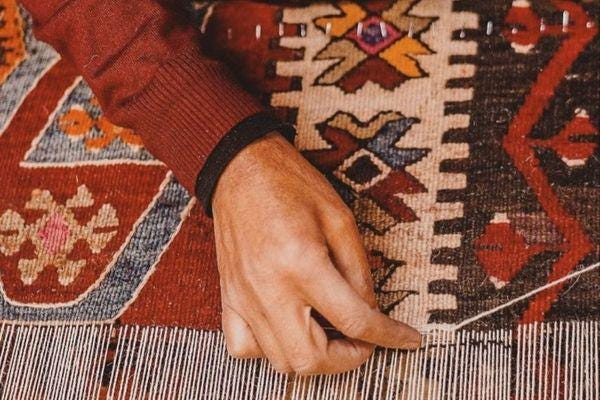
For centuries, woven textiles have done more than cover floors or soften walls. Across Persia and Anatolia, they have carried pattern through homes, courts, workshops and trade routes. Their surfaces could organize a room, preserve a visual rhythm and turn thread into a field of flowers, animals, geometry or script.But the language around them can be confusing. Is every Persian carpet a tapestry? Is a kilim the same thing as a rug? What makes an Anatolian flatweave different from a knotted carpet?This beginner's guide separates the terms, traces the Persian and Anatolian histories, and explains why these woven traditions still matter to contemporary textile wall art.
What Is a Tapestry?
Tapestry is first a weaving technique, not simply a name for any decorative fabric hung on a wall.Every woven textile begins with two systems of thread: the warp, held under tension on the loom, and the weft, passed across it. In tapestry weaving, tightly packed weft threads cover the warp. Different colored wefts are worked only where each color is needed, so the design is built into the textile itself.That last point matters: a true woven image is not an image printed on top of cloth. Pattern and structure arrive together.The word tapestry is also used more loosely in interiors and online shopping to describe textile wall hangings. That broader use is common, but it can blur several distinct traditions.
Persian Carpet, Persian Gelim and Anatolian Kilim: The Essential Difference
Three terms are often folded into one another:
- A pile carpet has a raised surface created by rows of knots secured around the warp, with wefts holding those rows in place.
- A kilim is a flatwoven textile with no knotted pile. In Turkish-speaking regions, the word commonly refers to flatweaves made in tapestry-related structures.
- A gelim—also written gelīm or gilim—is the related Persian term used in Iran for large flatwoven, often tapestry-woven textiles.
So, not every Persian carpet is a tapestry. The celebrated Persian pile carpet and the tapestry-woven Persian gelim belong to the same larger world of woven floor coverings and furnishings, but they are structurally different. Anatolian pile carpets and Anatolian kilims are different for the same reason.This is not a minor technicality. Structure influences texture, weight, drape and even the kinds of lines a weaver can create.
A Short History of Persian Woven Art
There is no neat origin story for Persian carpet or tapestry weaving. Textiles are vulnerable to moisture, insects and use, so early examples rarely survive. Scholars therefore work from fragments, written references and images as well as complete objects. Claims that one culture simply "invented" the carpet usually promise more certainty than the evidence allows.By the sixteenth century, however, Persian weaving had entered one of its most influential periods under Safavid rule. Court patronage connected textile production to the arts of the book. Medallions, scrolling vines, palmettes, flowers, animals, human figures and inscriptions moved between manuscript design and woven surfaces.The famous Ardabil Carpet, dated 1539–1540, is a knotted-pile carpet rather than a tapestry. It is useful here precisely because it shows why the categories matter: its immense pattern field was made with knots, while a remarkable group of Safavid gelims was tapestry-woven in silk and metal-wrapped threads. Some of those courtly gelims carried complex floral imagery; others included figures, animals, poetic inscriptions or royal arms.Possible production centers for these luxurious tapestry-woven gelims include Kashan, Isfahan and Tabriz. At the same time, weaving was never only a court art. In towns, villages and nomadic communities, flatweaves served daily life—as floor coverings, household furnishings, wrappings and portable forms of storage.Many surviving Persian tribal gelims date from the eighteenth and nineteenth centuries. Their geometry, color and regional construction reveal a vast field of local practices rather than one single "Persian style."
A Short History of Anatolian Carpets and Kilims
Anatolia—most of present-day Turkey—has long been a crossroads connecting the Mediterranean, the Caucasus, Iran and Central Asia. Its textile history reflects that movement. Court workshops, urban production, village weaving, nomadic life and international trade all shaped what we now group under the label Anatolian tapestry or Turkish textile art.Before the sixteenth century, Anatolian carpets were especially associated with bold geometric and stylized animal designs. During the Ottoman period, artistic exchange with Persia and Egypt helped bring new central-medallion layouts and flowing vegetation into court carpet design. The saz leaf, carnations, tulips, palmettes and the three-dot-and-wave çintamani motif circulated across carpets, silks, ceramics, book arts and other surfaces.Western Anatolian weaving centers such as Uşak became known for monumental medallion carpets. These were knotted-pile works, not kilims. Meanwhile, regional flatweave traditions continued. Anatolian kilims used tapestry structures to create strong fields of color, stepped forms, hooks, diamonds, rosettes and banded compositions.Anatolian carpets also traveled. They appear in European paintings and moved through international trade, becoming so familiar to art historians that some groups were later nicknamed after painters such as Holbein and Lotto. Western Anatolian carpets were imported into Europe in significant numbers during the seventeenth and eighteenth centuries.Yet the history is not only the story of courts and export. Many village and nomadic textiles were designed and woven by women, with knowledge moving through families and communities. The loom was not merely a production tool. It was part of domestic space, material memory and everyday problem-solving.
Why Do Kilims Use So Much Geometry?
Geometry in a kilim is not simply a decorative preference. It is partly a conversation with the loom.In slit-tapestry weaving, a colored weft turns back where its color area ends. The neighboring color does the same, leaving a small vertical opening—or slit—between the two fields. Diagonal and stepped forms work naturally with this process. Smooth curves demand more time, finer materials or additional techniques.This is why diamonds, hooks, zigzags, stepped edges and repeated bands can feel so structurally at home in a flatweave. The weaver is not forcing a drawing onto fabric. The design grows from the logic of interlaced thread.
How to Read the Pattern Without Inventing a Myth
Historical textiles are often marketed with fixed motif dictionaries: one hook always means protection, one diamond always means fertility, one color always carries a single message. The reality is more interesting—and less tidy.Meanings can shift between regions, communities, periods and individual weavers. A motif may carry an association, solve a structural problem, balance a composition, recall another textile or simply be visually satisfying. Persian and Anatolian weaving traditions also influenced one another and drew from neighboring visual cultures.A more useful way to look is to notice how the textile is organized:
- Field: the main patterned area
- Border: the frame that contains or redirects the field
- Medallion: a central or repeated focal form
- Repeat: a motif arranged in rhythm across the surface
- Palette: the color relationships that control contrast and depth
- Scale: the way a pattern changes when seen across a room or close to the thread
Pattern can behave like language without becoming a codebook in which every mark has one permanent translation.
From Floor Covering to Woven Wall Art
Persian gelims and Anatolian kilims were not created only as wall decoration. They could cover floors and furnishings, divide or soften space, wrap possessions and support mobile life. Their modern display on walls changes the context, but not the material intelligence of the object.A textile wall hanging does something a framed print cannot. It absorbs light rather than reflecting it. It adds softness without losing visual scale. Its weave becomes visible as the viewer approaches, so the work can read as architecture from across the room and as thread up close.Contemporary jacquard weaving is different from a handwoven kilim and different again from a knotted carpet. What connects them is not a claim of sameness. It is the deeper proposition that an image can be constructed through thread—and that pattern can give a room a center.
What This History Means to JacquardiaCo
At JacquardiaCo, history is not a costume. Our work is not presented as antique, handwoven, Persian or Anatolian. We create contemporary jacquard-woven textile art: pattern-led objects designed to live on walls, beds, sofas and inside collected rooms.The historical lesson we carry forward is simpler and more demanding: pattern is language, and textile is memory. A woven piece should not feel like a poster pretending to be cloth. Its visible weave, softened color, border, scale and tactile presence are part of the image.Some patterns merely fill a surface. Others make the surface feel as if it is trying to say something. We are interested in the second kind.Explore JacquardiaCo woven wall textiles and pattern-led objects.
Persian and Anatolian Tapestry FAQ
Are Persian carpets tapestries?
Not always. Many Persian carpets are knotted-pile textiles. Persian gelims are flatwoven and commonly use tapestry-weave structures. Both are woven art, but their construction and surface are different.
What is the difference between a kilim and a tapestry?
Tapestry describes a weaving technique in which colored wefts build the design and cover the warp. Kilim refers to a family of flatwoven textiles, many of which use slit-tapestry or related techniques. The terms overlap, but they are not perfect synonyms.
Is an Anatolian kilim the same as a Turkish rug?
An Anatolian kilim can be called a Turkish flatweave, but "Turkish rug" is broader and may also describe knotted-pile carpets. Anatolia's textile history also includes many communities, regions and periods, so one national label cannot explain every object.
Is jacquard tapestry the same as a handwoven kilim?
No. Both build imagery through woven structure, but they use different loom systems, constructions and production contexts. A contemporary jacquard-woven wall textile should not be described as a handwoven kilim unless it genuinely is one.
Can kilims and woven textiles be displayed as wall art?
Yes. Many collectors use flatweaves and contemporary woven textiles as wall hangings because they bring pattern, scale, softness and visible texture into a room. The correct hanging method depends on the textile's weight, age and condition.